Customer Support
Generators
CO Shield
CO Shield Questions
Q1: Can I operate my generator inside a shed away from my home?
Q2: Can I operate my generator inside my garage with the exhaust pointing outside?
Q3: Can I operate my generator on my covered porch with the windows and doors closed?
Q4: When the generator shuts off from CO, what should I do next?
Q5: If I approach the generator that has been shut off, and there are no blinking lights, how do I determine what caused the shutoff?
Q6: Why do I still have a CO shutoff if I properly placed my generator outdoors with the exhaust pointing away?
Q7: When the generator shuts off from CO, when can I try to restart it?
Q8: Does CO Shield monitor indoor CO levels?
Q9: Will CO Shield work when my generator is running on propane or natural gas?
Q10: I use my Storm Shield tent to protect my generator from the rain. Will it cause shutoff due to elevated CO under the tent?
Q11: Can I change the sensitivity or disconnect the CO Shield device if it keeps shutting off the generator?
Q12: What can I do to test the CO shutoff feature and make sure it's working?
Q13: How do I run my generator in the rain if I'm instructed to operate my generator outdoors, far away from occupied buildings with the exhaust pointed away from people and buildings?
Q14: Why does my generator’s wireless remote-start feature not work after a CO shutoff event?
CO Shield Videos
CO Shield® - CO Sensor Sensitivity
CO Shield® - Remote-Start Feature not Working after a CO Shutoff
CO Shield® - CO Shutdown & What to do Next
CO Shield® - No Blinking Lights after Generator Shutdown
CO Shield® - Operating on Propane or Natural Gas
CO Shield® - When to Restart a Generator after a CO Shutdown
CO Shield® - Indoor CO Levels
CO Shield® - Portable Generator Outdoor Operation with a CO Sensor
CO Shield® - Carbon Monoxide & Your Storm Shield
CO Shield® - Testing the CO Shutoff Feature
CO Shield® - Safely Operating a Portable Generator in the Rain
CO Shield® - Proper Generator Location Operation
CO Shield® - The Carbon Monoxide Auto-Shutoff System
FAQ
How to safely operate a portable generator.
What is the difference between running watts and starting watts?
Carbon monixide is DANGEROUS.
How to Choose and Use a Generator
Generator and Inverter Storage
Total Harmonic Distortion
Portable Generator Warranty
Storm Shield Generator Cover Compatibility.
Cold/Hard Starting Tip
Wattage Reference Chart
Spark Plug Adjustment and Replacement
Calculating Wattage
Cleaning and Replacing Your Spark Arrestor
How to Drain a Generator's Fuel Tank
Locating, Cleaning, and Replacing Your Dual Fuel Generator's Fuel-Cut Solenoid
Using Your Dual Fuel Propane Quick-Connect Hose
Connecting Your Battery
Carburetor Cleaning (Generator or Inverter)
Portable Generator Intelligauge Display
Grounding
Converting Your Open Frame Generator to Floating Neutral
Converting Your Open Frame Inverter to Floating Neutral (100519)
I am finding an open ground or reverse polarity on my generator.
Disconnecting the Bonded Neutral on GFCI Units for Refrigerator Operation
Converting Your Open Frame Generator to Floating Neutral (100496 and 100538)
Converting Your Open Frame Inverter from Floating to Bonded Neutral
Converting Your Open Frame Inverter to Floating Neutral (100520)
Bonding Neutral to Ground (100573)
Grounding
Converting Your Open Frame Inverter to Floating Neutral (201066, 201067)
Home Standby Generators
FAQ
Home Standby Generator Battery Requirement
Optimal Placement of a Home Standby Generator
Understanding Your Home's Electrical Service Size
Home Standby Generator Warranty
Types of Circuits in an Electrical Panel
Tech Bulletins
Inverters
FAQ
Tech Bulletins
Valve Adjustments (2000-Watt Inverters)
Valve Adjustments (3000+ Watt Inverters)
Testing the 2000-Watt Inverter Ignition Coil (Cubed)
Recoil Replacement (Clamshell Inverters)
Recoil Replacement (Cube Inverters)
High Altitude Jet Installation (2,800+ Watt Inverters)
Recoil Replacement (3100+ Watt Inverters)
Ignition Assembly Replacement for 2000-Watt (Cubed) Inverters
Carburetor Replacement (2000-watt Cubed Inverters)
Fuel Tank Replacement (3100-watt Inverters)
Muffler Replacement (3100-watt Inverters)
Fuel Tank Light Indicator Battery Replacement
Control Unit Replacement (2000W Cubed Inverters)
Control Unit Replacement (2000-2500W Inverters)
Intelligauge Replacement (6500 Watt Inverters)
Recoil Replacement (4500W+ Inverters)
Adding and Changing Oil (Large Open Frame Inverters)
Carburetor Replacement (201066, 201067)
Recoil Replacement (100692)
Remote Module Replacement (4500+ Watt Remote-Start Inverters)
Air Filter Cleaning and Replacement (Cubed Inverters)
Control Unit Replacement (201066, 201067)
CO Module Replacement (201049, 200978)
Carburetor Replacement (11,000 Watt Inverters)
Carburetor Replacement (3100-3500-Watt Dual-Fuel Inverters)
Control Unit Replacement (Open Frame Inverters)
Control Unit Replacement (Open Frame Inverter)
Control Unit Replacement (11,000 Watt Inverters)
Recoil Replacement (Open Frame Inverters)
Carburetor Replacement (201176, 201178)
Control Unit and Recoil Replacement (2000W+ Inverters)
Carburetor Replacement (Open Frame Inverters - 100302, 100371)
Carburetor Replacement (201003)
Control Unit Replacement (2000-Watt Clamshell Inverter)
Converting Your Inverter to Floating Neutral (201238)
Control Unit Replacement (4500W+ Inverters)
Carburetor Replacement (100573)
Adding and Changing Oil (Standard Open Frame Inverters)
Carburetor Replacement (4500W+ Remote-Start Inverters)
Remote Module Replacement (Remote-Start Inverters)
Air Filter Cleaning and Replacement (3100-3500-Watt Inverters)
Adding and Changing Oil (3000+ Watt Inverters)
Carburetor Replacement (Dual-Fuel Open Frame Inverter)
Intelligauge Replacement (100719)
Carburetor Replacement (Remote-Start Inverters)
Carburetor Replacement (Remote-Start Open Frame Inverters)
Valve Adjustments (4500-4650-Watt Inverters)
Control Unit Replacement 100719 , 201175
CO Shield Module Replacement (100719)
Carburetor Replacement (2000-Watt Clamshell Inverters)
Converting Your Open Frame Inverter to Floating Neutral (201176, 201178)
Carburetor Replacement (3100-3500-Watt Gasoline-Only Inverters)
Dual Fuel Inverter Start-Up Procedure (2000-2500W)
High Altitude Jet Installation (100519, 100520)
Recoil Replacement (2800W+ Dual Fuel Inverters)
Adding and Changing Oil (4500-4650-Watt Inverters)
Carburetor Replacement (6500 Watt Inverters)
Relay Starter Replacement (3100-watt Inverters)
Carburetor Replacement (100692)
Intelligauge Replacement (11,000 Watt Inverters)
Recoil Replacement (201001, 201003)
Carburetor Replacement (201175)
Starter Motor and Ignition Coil Replacement (3000+ Watt Inverters)
Carburetor Replacement (100478)
CO Module Replacement (Large Open Frame Inverters)
Control Unit Replacement (3100-3500-Watt Inverters)
Control Unit Replacement (100519, 100520)
Starter Relay Replacement (4500-5500W Inverters)
Carburetor Replacement (201054)
Converting Your Inverter to Floating Neutral (100719)
Intelligauge Replacement (4500+ Watt Inverters)
Carburetor Replacement (2000+ Watt Inverters)
Converting Your Inverter to Floating Neutral (201407)
Carburetor Replacement (100574)
Carburetor Replacement (4500W+ Dual Fuel Inverters)
Carburetor Replacement (201001)
Wheel Kit Installation (100302)
Adding and Changing Oil (2000-Watt Clamshell Inverter)
Control Unit and Recoil Replacement (Open Frame Inverter)
Carburetor Replacement (201049)
Carburetor Replacement (Open Frame Inverters)
Control Unit Replacement (6500 Watt Inverters)
Inverter Air Filter Cleaning and Replacement (2000-Watt Clamshell Inverters)
Control Unit Replacement (100478)
Carburetor Replacement (200978)
Adding and Changing Oil (5500-Watt Inverters)
Converting Your Inverter to Floating Neutral (201417)
Control Unit Replacement (5000W+ Inverters)
Carburetor Replacement (100719)
Recoil Replacement (100478)
Cleaning the Pilot Jet (2000-3500-Watt Inverters)
CO Shield Module Replacement (2500-Watt Inverters)
Carburetor Replacement (2000-2500-Watt Inverter)
Open Frame Inverter Starter Motor Replacement (201176)
Recoil Replacement (4000 - 4500 Watt Inverter)
Remote Module Replacement (11kw Remote Start Inverters )
Starter Motor Replacement (4500-5500 Watt Inverters)
Open Frame Generators
FAQ
Voltage Toggle Switch Wiring
Dual Fuel Selector
EFI Generator Fault Codes
EFI System Component Locations
Removing Shipping Brackets
Tech Bulletins
Valve Adjustments (1800-Watt and Below Generators)
How to Adjust RPM and Frequency for Optimal Generator Performance
How to Adjust a Portable Generator AVR Safely and Effectively
Valve Adjustments
How to Test a Brushless Generator
Electrical Output Testing Procedure
Polarization Test
End Cover Assembly Installation
Installation of the On/Off Switch (196cc)
196cc Carburetor Installation
Circuit Breaker Installation
AVR and Brush Assembly Replacement
Installation of the On/Off Switch (270cc - 337cc)
High Altitude Jet Installation
46538 Charge Diode Removal
Carburetor Replacement 41332 and 41532 (Choke Dampener Spring)
Gas Tank Replacement
Air Supply Hose Replacement
Choke Lever Replacement (196cc Gasoline Engine)
Choke Plate Replacement
Generator Fuel Valve Replacement: What You Need to Know
My Open Frame Generator Won't Start.
Rotor, Stator or Engine Removal with Champion Puller
Starting a Generator with a Broken Recoil Rope
Remote FOB Battery Replacement
Soldering Broken Rotor Wire
Reprogram Wireless Remote (Rocker Switch Generators)
Basic Diagnostics for Testing AC Output
Fixing a Flooding Carburetor
Reprogram Wireless Remote (Push-Button Generators)
How to Start a Generator Without Keys: Troubleshooting Tips
Mobility Kit Installation (Axle)
40065 Support Leg Installation
Throttle Body Replacement (EFI Generators)
Carburetor Replacement (Tri-Fuel Generator)
Ajuste de las Valvulas
Temporarily Disconnect Your Generator's Low-Oil Shutoff Sensor
CO Module Replacement (Open Frame Generators)
Remote Control Module Replacement - Open Frame Generator
CO Module Replacement (Electronic Fuel Injection Generators)
Carburetor Replacement (Remote-Start Generators)
Recoil Replacement (Open Frame Generators)
Adding and Changing Oil (114cc-224cc Generators)
Pilot Jet Cleaning (196cc-459cc Open Frame Generators)
Carburetor Replacement (6250-8000-Watt Dual-Fuel Generators)
How to Handle a Tripped GFCI Outlet
Wheel Kit Installation (40065)
Choke Lever Replacement (3000-4000-watt Generators)
Fuel Pump Replacement (EFI Generators)
Starter Motor Replacement 100111,201160, 201414 & 201241
Procédure de Test de Sortie Electrique
Oxygen Sensor Replacement (EFI Generators)
Carburetor Replacement (80cc Synchronous Generators)
Carburetor Replacement (100111)
Carburetor Replacement (5000-10,000-Watt Generators)
Instalacion de Disyuntores
Remote Module Replacement (Remote-Start Generators)
Carburetor Replacement (100519, 100520)
CO Shield Module Replacement (201072, 201076)
Generator End Cover Replacement
Temperature Sensor Replacement (EFI Generators)
Carburetor Replacement (3500-4750-Watt Dual-Fuel Generators)
Carburetor Replacement (3000-4000-Watt Gasoline-Only Open Frame Generators)
Carburetor Replacement (Remote-Start Generators)
Mi Generador no Arranca
Adding and Changing Oil (270cc-459cc Generators)
CO Shield Module Replacement (4500/4650-Watt Inverters)
Ignition Coil Replacement Instructions for Champion Models
Air Filter Cleaning and Replacement (Open Frame Generators)
Fuel Injector Replacement (EFI Generators)
Questions
Why does my generator not shut off when using propane?
How does the three position toggle switch control the voltage of my generator?
Should I Use a Surge Protector?
Why Does My Generator Abruptly Stop after 20-40 Minutes?
How do I fix a broken choke lever?
Why is my generator galloping in rolling cycles?
Can I use the twist-lock receptacle on my generator with my RV?
What are the differences between Emergency, Standby, and Prime Power applications?
Manual Transfer Switches (MTS)
Engines
FAQ
Finding the Engine's Manufacturer Date (Pre-2011 Engines)
Spark Plug Specifications: OEM vs. Replacement Types
Basic Service Information for Champion Engines 196cc and above.
Checking for Specifications in the Owner's Manual
Metric Bolt Marking and Torque Values
Tech Bulletins
Adjust the Governor Droop
Small Block Engine Governor Adjustment
Big Block Engine Governor Adjustment
Engine Speed Setting Adjustment
Installation of the Push Rod Guide Plate
Fix a Broken Recoil Rope (All Gasoline Engines)
Resetting the Governor to WOT
Basic Engine Diagnostics
High Altitude Jet Installation (717cc Engines)
Fuel Flow Test, Carburetor Jet Service Procedures
Carburetor Replacement (338cc and 389cc Engines)
Carburetor Replacement (196cc and 224cc Engines)
Engine Oil
What Type of Engine Oil to Use for Optimal Performance
Engine Oil Capacity
Oil Viscosity Recommendation
Synthetic Oil
80cc Engines
2000-Watt Inverters
3100-3400-watt Inverters
114cc-224cc Engines
208cc-224cc Engines
270cc-459cc Engines
439cc Engines in 8.5kW Home Standby Generators
717cc V-Twin Engine
717cc-754cc Home Standby Generators
Lawn & Garden
Chainsaws
Chainsaw Setup and Startup
Chainsaw Chain Tension Adjustment
Chainsaw Oil Flow Adjustment
Chain Replacements
Chipper Shredders
Cultivators & Tillers
Edgers
FAQ
Leaf Blowers
23cc Handheld Leaf Blower Gas Tank Replacement
23cc Handheld Leaf Blower Carburetor & Gasket Replacement
Leaf Blower Assembly and Operation (200934)
Yard Trimmers
Log Splitters
Pressure Washers
Snow Blowers & Plows
FAQ
Snow Blower Tips
How to Prevent a Clogged Snow Blower Chute
ATV Snow Plow Application Chart
Yardworks Snow Blower Maintenance Guides
Recommandations D’Entreposage
Storage Recommendations
Long Term Storage (Snow Blowers)
Tech Bulletins
Certified Snow Blower Cable Assembly
Certified Snow Blowers Startup Procedure
Procédure de démarrage des souffleuses à neiges Certified
100435 (060-3732-6) 22" Snow Blower - Model Year 17 Auger Belt Replacement
Souffleuse à 22 po 100435 (060‐3732‐6) Conversion de l'année modèle 17 à l'année modèle 18
Assemblage de câble de souffleuse à neige Certified
100435 (060-3732-6) 22" Snow Blower - Model Year 17 to model year 18 Conversion
100435 (060‐3732‐6) Souffleuse à neige de 22 po. L’année modèle 17 Remplacement de la courroie de tarière.
Remplacement de palier sphérique de souffleuse à neige Certified
Snow Blower Auger Belt Replacement (100535, 100536)
Snow Blower Valve Adjustment
Snow Blower Troubleshooting
Snow Shoe Adjustment (Snow Blowers)
Adding and Changing Oil (Snow Blowers)
Snow Blower Cable Adjustment
Startup (Snow Blowers)
Friction Disc Replacement (Snow Blowers)
High Altitude Jet Installation (Snow Blowers)
Certified Snow Blower Spherical Bearing Replacement
Snow Blower Cable Adjustment (100535, 100536)
Shear Pin Replacement (Snow Blowers)
Hex Shaft Lubrication (Snow Blowers)
Snow Blower Wheel Options
Transfer Pumps
Winches & Hoists
- All Categories
- Generators
- Inverters
- Tech Bulletins
- Relay Starter Replacement (3100-watt Inverters)
Relay Starter Replacement (3100-watt Inverters)
190513-60-50-1 The following bulletin covers the following models: 75537i, 100204, 100261, 100262, 100263, 100264, 100477 - Dual Fuel, Electric-Start, or Wireless Remote-Start 2800-watt + inverters.…

190513-60-50-1
The following bulletin covers the following models: 75537i, 100204, 100261, 100262, 100263, 100264, 100477 - Dual Fuel, Electric-Start, or Wireless Remote-Start 2800-watt + inverters.
*Specification, descriptions, and illustrations are as accurate as known at the time of publication but are subject to change without notice.
- To reduce the risk of injury, the user must read and understand the operator's manual before using this product.
- DO NOT make any adjustments to the generator without first stopping the engine, turning all the switches to the "OFF" position, closing the fuel valve, and disconnecting the spark plug wire.
- Burns from hot parts - let the engine cool for 30 minutes before touching any hot parts.
- Injury from moving parts.
- To reduce the possibility of fire or explosion, be careful when working around gasoline. Keep cigarettes, sparks, and flames away from all fuel-related parts.
Tools Required
Tool | Size |
Ratchet | 3/8" |
Sockets | 7 mm, 8 mm, 10 mm |
Pliers | Box nose |
Phillips Screwdriver | #2 |
Crescent Wrenches | 7 mm, 8 mm |
Empty Gas Container | Minimum two gallons |
Nitrile Gloves | |
*3 - Containers or boxes for parts | Small to Medium |
*Containers or boxes will help organize/identify parts when reassembling.
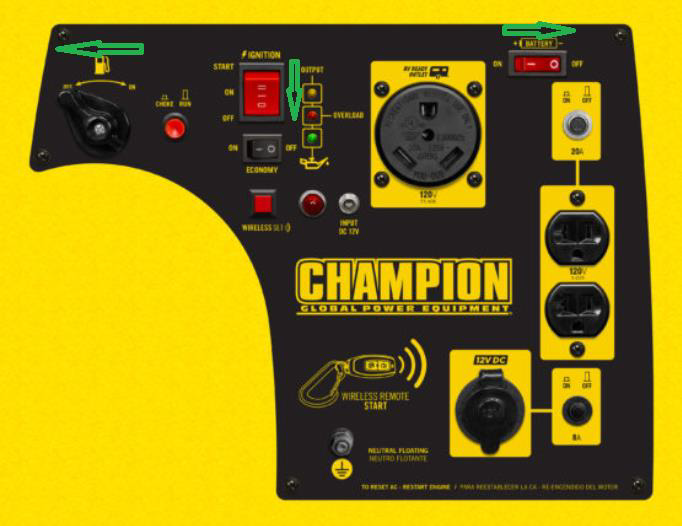
- Ensure the Fuel Valve, Battery, and Start switches are in the "OFF" positions. (Panel illustrated below is from model 75537i)
Visual
See below.
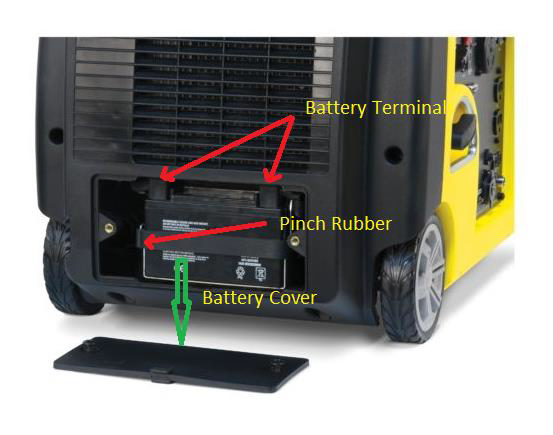
- Remove the two Phillips screws from the battery maintenance cover and pull on the rubber tab to access the battery. Un-clip the pinch rubber and slide the battery back to access cables. Pull back on the protective boots to expose the battery bolts and, using a 10 mm wrench or socket, remove the Black (-) negative cable first and then remove the Red (+) positive cable. (Put all battery parts into a tray and label it "Battery Parts.")
Visual
See below.
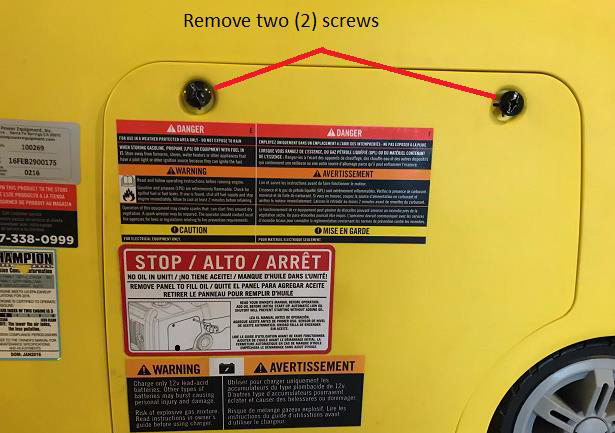
- Remove the two Phillips screws to remove the access panel.
Visual
See below.
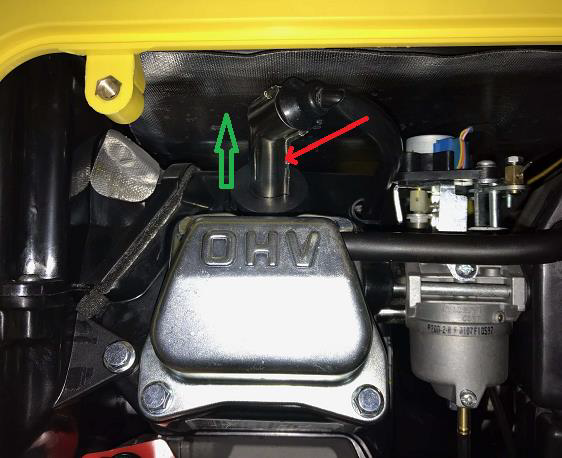
- Gently pull the spark plug cap by firmly grasping the spark plug insulator at the base. Leave it disconnected while working on the unit.
Visual
See below.
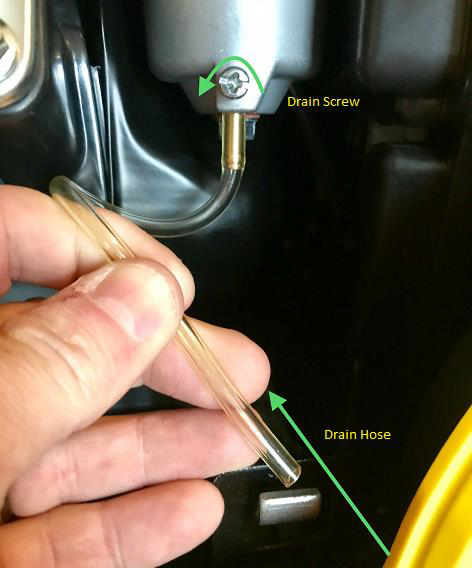
- Remove the clear or pink carburetor drain hose from the drain hole in the base of the enclosure and extend the hose to the exterior and direct it into your gasoline container. Turn the main fuel valve to the "ON" ("gasoline" position for Dual-Fuel units) and with the hose securely positioned into your gasoline can, loosen the drain screw only enough until you see gas flowing. After the fuel tank is completely empty, close the drain screw, turn the fuel valve "OFF," and insert the drain hose back into the drain hole of the base of the enclosure.
Visual
See below.
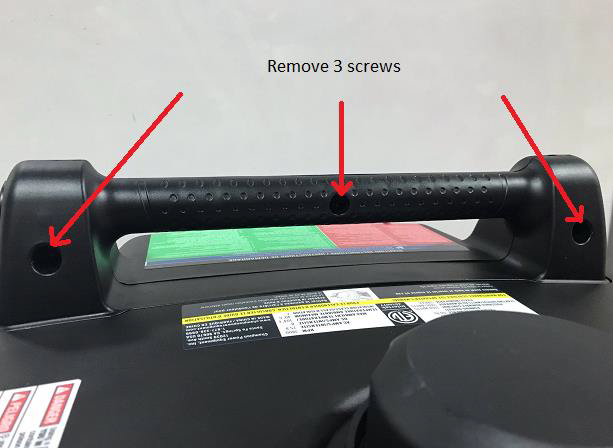
- On the top handle of both side, with a Phillips screwdriver, remove the three Phillips screws facing the gas cap.
Visual
See below.
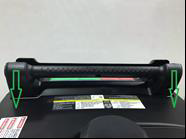
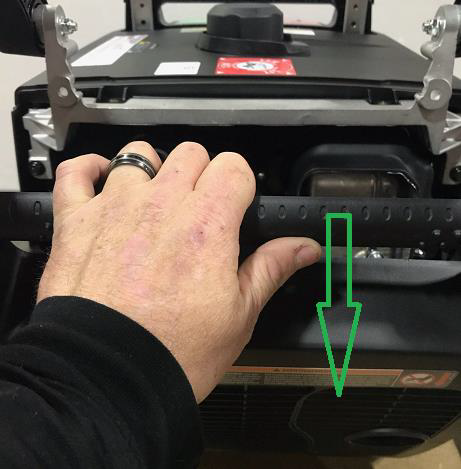
- Separate the handle along the center seam and pull downwards toward the top of the unit. (Put all parts into a box and label it "Top/Handle Parts.")
Visual
See below.
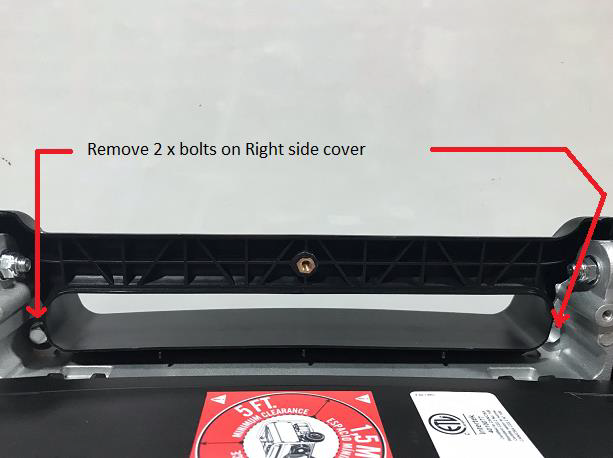
- Located on the right side of the metal frame, remove the two bolts with a ratchet and 10 mm socket. (Put all parts into a box and label it "Right Side Parts.")
Visual
See below.
- With a Phillips screwdriver, remove the two screws on each side and then, with a ratchet using a 10 mm socket, remove the two shoulder bolts at the bottom.
Visual
See below.
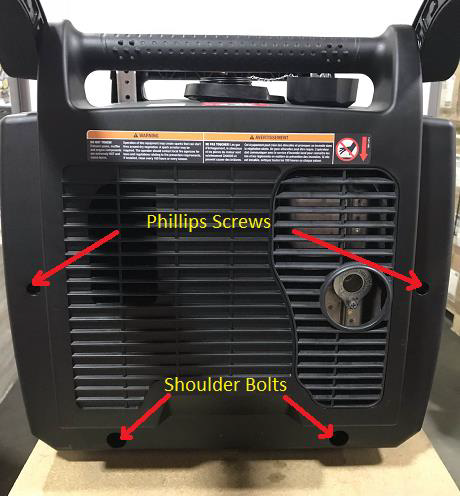
- Remove the right side cover (Handle side). (Place hardware into a tray already labled "Right Side Cover.)
Visual
See below.
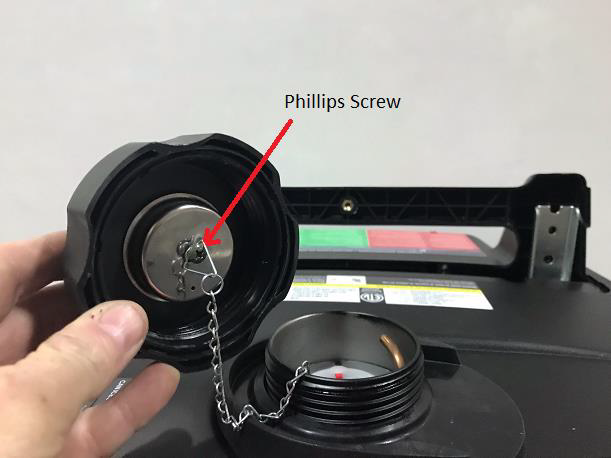
- Unscrew the gas cap and remove the Phillips screw. Place the gas cap to the side. (We suggest you thread the screw back into the cap, so as not to misplace.)
Visual
See below.
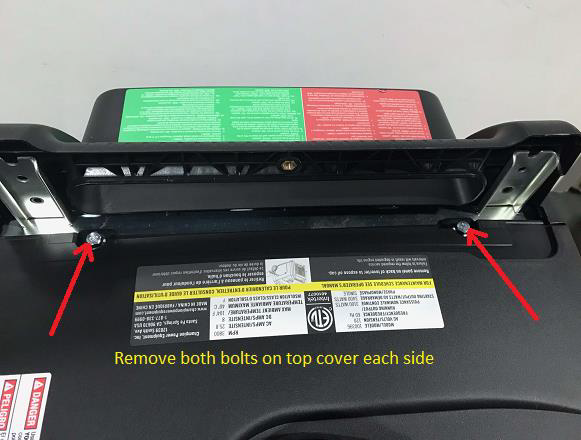
- Remove the top cover by removing the four bolts (two on each side) with a 10 mm socket. (Put all the parts into a box labeled "Top/Handle Parts.")
Visual
See below.
- Gently push up on the top cover; the top will unsnap out of place. Replace the gas cap on the tank.
Visual
See below.
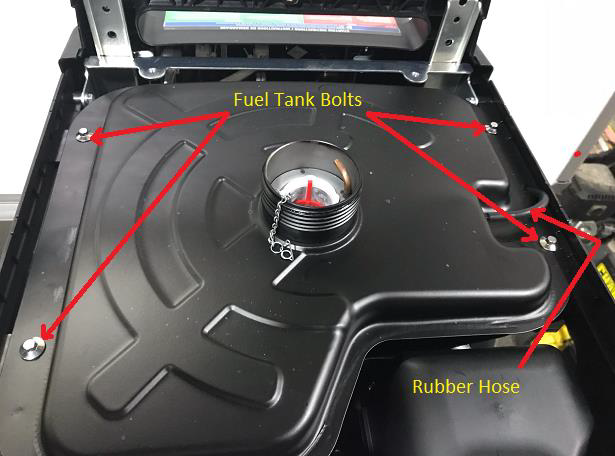
- Remove the four fuel tank bolts with a 7 mm socket. Remove the rubber hose on the top by gently twisting and pulling it with your fingers. (Put all the parts into a box labeled "Top/Handle Parts.")
Visual
See below.
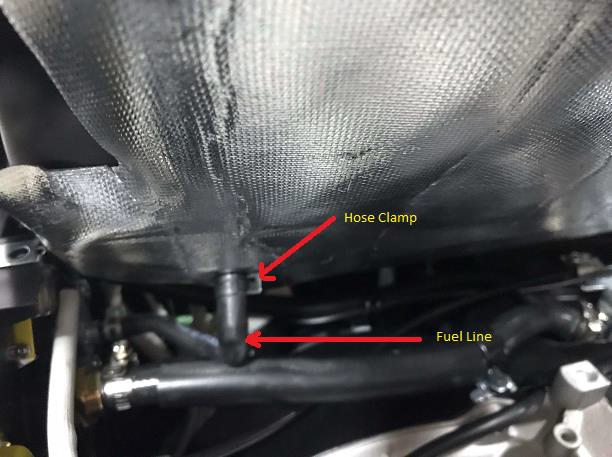
- Gently lift-up on the gas tank and locate the hose clamp securing the fuel line in place. (Make sure the gas tank is empty if you have not already done so in step #6 before removing the fuel line.) Using your pliers, pinch the clamp to expand it and gently wiggle the fuel link and clamp it off. Once removed (gas cap on the tank), place the tank in a safe location, away from cigarettes, sparks, and flames.
Visual
See below.
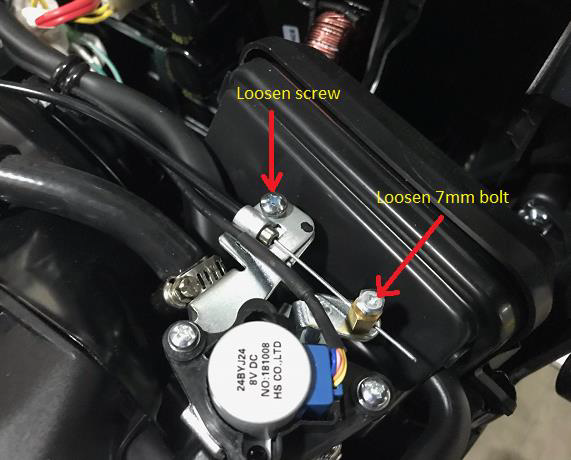
- Loosen the choke cable clamp screw and loosen the cable wire clamp using a 7 mm and 8 mm wrench. Remove the choke cable from the pinch bolt, and allow the cable to lay loosely, so we can remove the front panel in a later step.
Visual
See below.
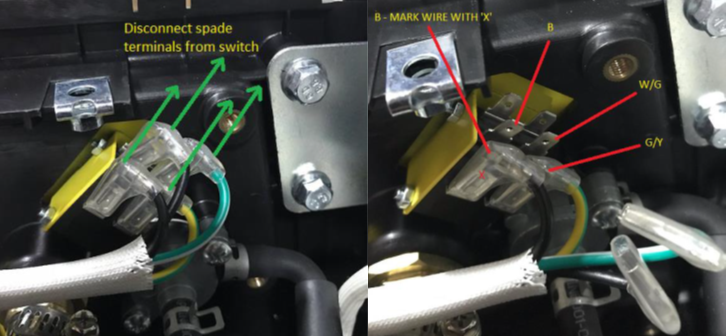
- If a unit is a dual-fuel model, take note of which wires go to which terminals. We suggest you take a picture then disconnect the spade terminals. There are six connections and we only use four, so we recommend you take a picture!
Visual
See below.
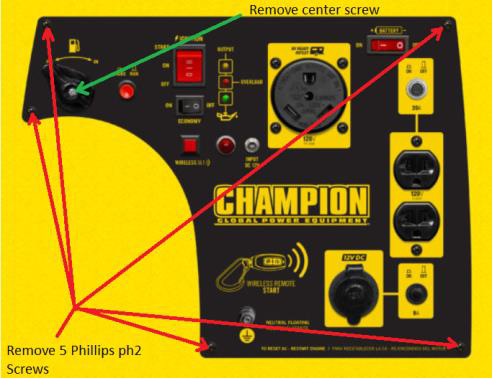
- On the front panel, remove the five screws as indicated. Remove the center screw and pull off the fuel knob and place it to the side. DO NOT lose the small center screw. (Put all parts into a box and label it "Front Panel.")
Visual
See below.
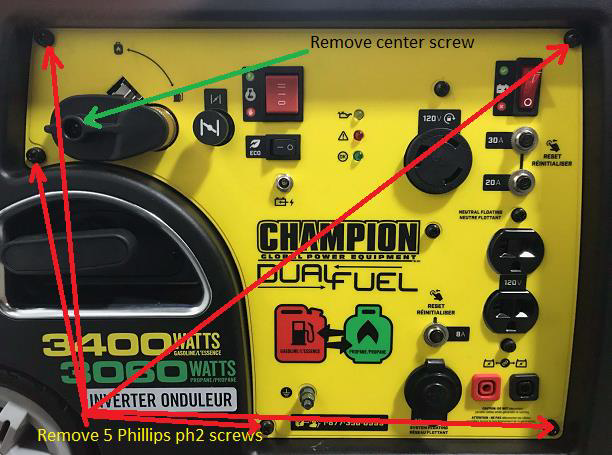
- FOR DUAL-FUEL MODELS ONLY - Remove the five front panel screws as indicated. Holding the fuel knob in the "OFF" position, remove the center screw and pull off the fuel knob and place it to the side. DO NOT lose the small center screw. (Put all parts into a box and label it "Front Panel.")
Visual
See below.
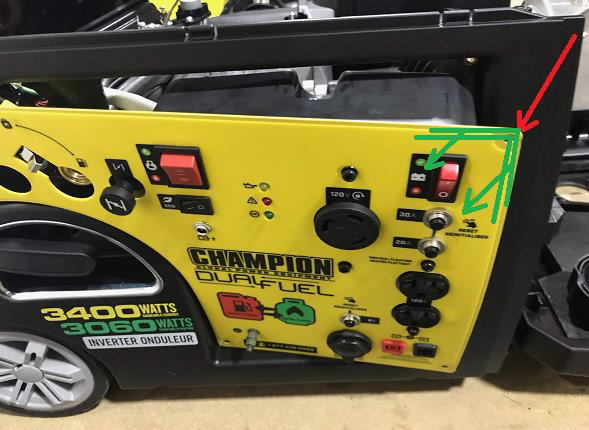
- Once all the screws are removed, gently pull out on the top right-hand corner, and swing out the panel slowly; DO NOT FORCE.
Visual
See below.
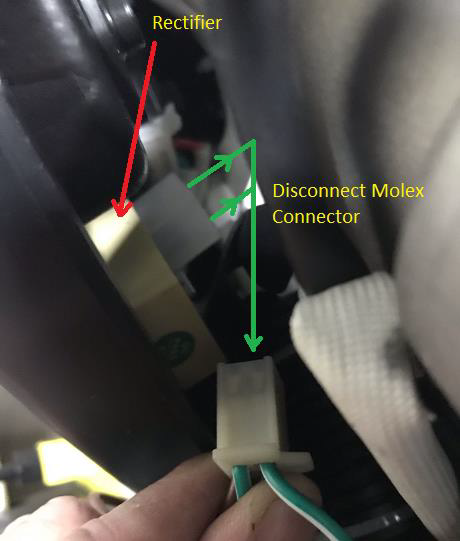
- Located on the inside left front panel below the recoil cord, disconnect the Molex connector from the Rectifier. This will enable you to achieve more room to open the front panel.
Visual
See below.
- Directly in front of you, against the engine block, you will see the starter solenoid and starter motor. Inspect the black solenoid wire for damaged wire insulator as shown in the picture. Use electric tape to cover the exposed copper wire and wrap firmly with at least three to four layers.
Visual
See below.
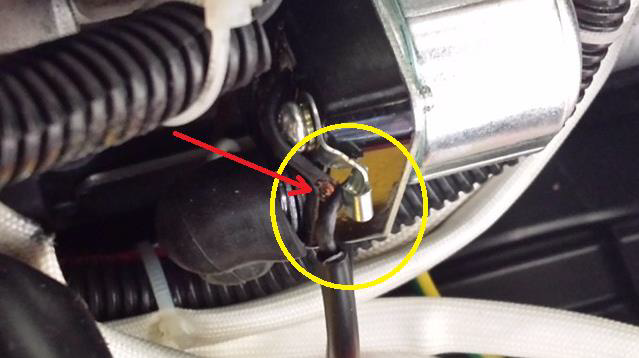
- (A) Remove the factory-installed zip tie and install a new zip tie after creating additional free play on the black solenoid wire. (B) Loosen the vibration support strap to rotate from outward to upward and re-tighten. (C) If replacing the solenoid, remove the single bolt with a 10 mm socket disconnect wires and install new ones. Make sure the cable routing is correct. Reverse these steps for reassembly.
View and download the PDF version here.
How did we do?
Carburetor Replacement (6500 Watt Inverters)
Carburetor Replacement (100692)